
Integrated workflow
Ten steps, four critical quality gates. No further step is taken without approval at marked stops.
-
1. adım: Material Reception
Incoming material is checked according to specifications.
-
2. adım: Pre-Cleaning
Surface is cleared of dirt, oil, and foreign matter.
-
3. adım: Grit Blasting
Surface roughness is achieved in accordance with standards.
-
4. adım: Surface Inspection
Sa degree, profile, and surface condition are checked.
Quality gate. Surface approval is given after grit blasting.
-
5. adım: Coating Preparation
Ambient and surface conditions are measured, suitability is confirmed.
Quality gate. Climate control is performed before coating.
-
6. adım: Airless Application
Application is performed at the specified system and thickness.
-
7. adım: Intercoat Inspection
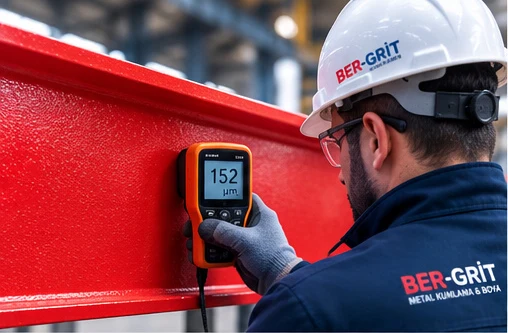
Checked with DFT measurement after each layer.
Quality gate. Layer DFT and recoat control are recorded.
-
8. adım: Drying and Curing
The curing process is monitored according to product technical requirements.
-
9. adım: Final Quality
All criteria are checked and approved.
Quality gate. Final visual and total DFT acceptance is performed.
-
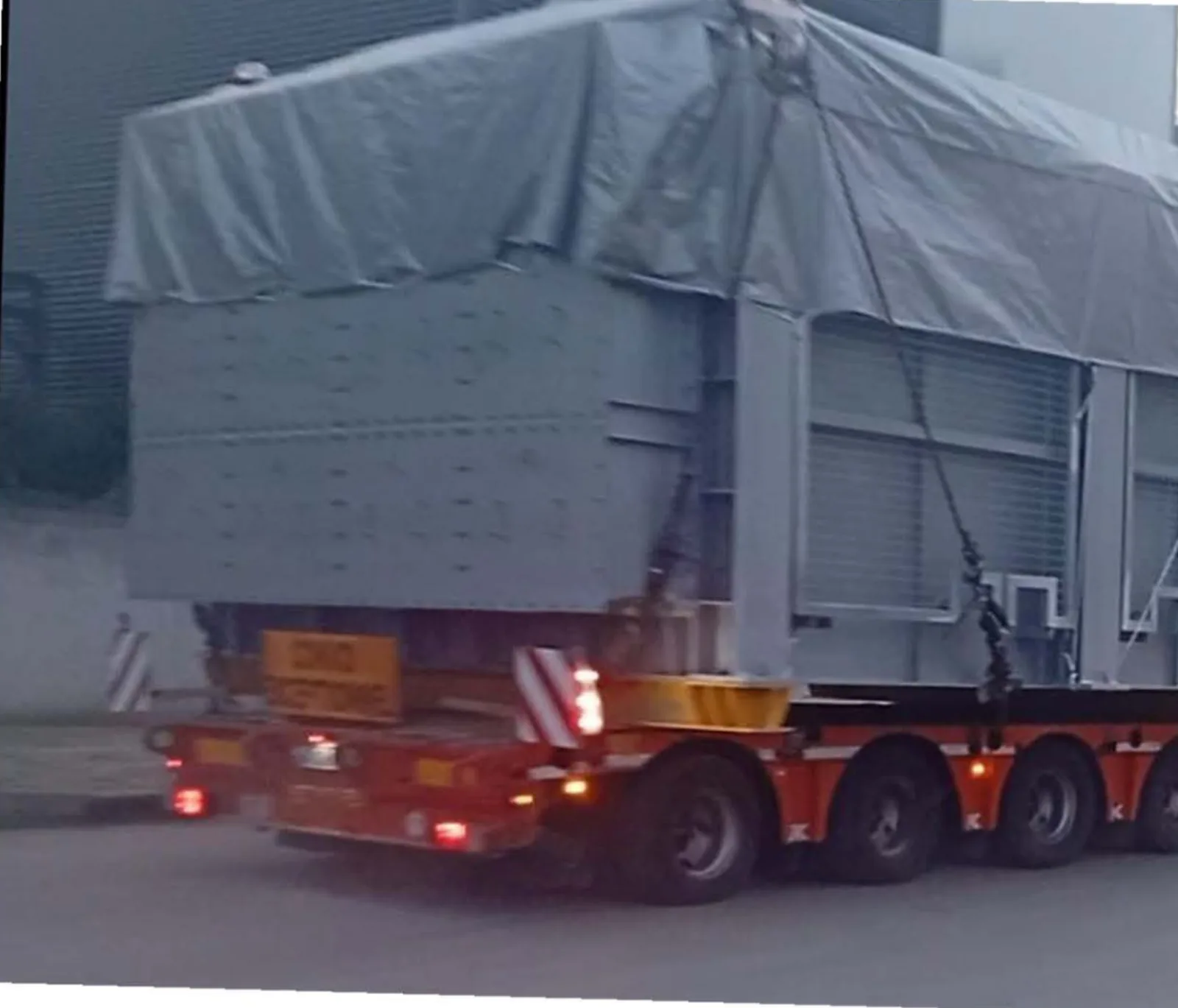
10. adım: Packaging and Shipment
It is packaged appropriately and made ready for shipment.
Records are taken at marked stops and the next step is not taken without approval.
The final step has its own principles: packaging and shipment booklet describes packaging types, protection methods, and the shipment checklist.
Recorded Items
Measurement and approval records are kept in six stages. Records are linked to the work order and collected in the delivery file.
| Order | Stage | Recorded Items |
|---|---|---|
| 01 | Material Acceptance | Identity, quantity, damage, surface condition |
| 02 | Pre-blasting | Oil and grease, welding, edge, masking |
| 03 | After blasting | Sa degree, profile, dust and visual inspection |
| 04 | Pre-paint climate | Air and surface temperature, relative humidity, dew point |
| 05 | Application control | Batch, mix, WFT, recoat, DFT |
| 06 | Final and dispatch | Color, total DFT, NCR closure, report package |
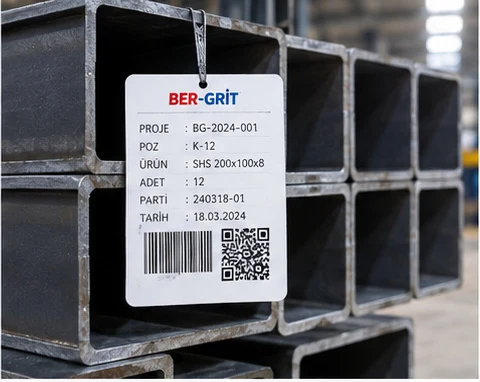
Records included in the delivery file
- Blasting report
- Climate form
- Paint batch and mix record
- WFT / DFT report
- Final inspection
- Dispatch file
ITP inspection points
Documents and measurements match at eight points. Thus, the work is managed not only as application but also as a measurable delivery file.
-
01
Contract and specification
PO, drawing, paint system, standard and report scope
-
02
Material receiving
Identity, quantity, damage, surface condition and stock registration
-
03
Paint input control
Product, batch, shelf life, TDS and SDS acceptance record
-
04
Blasting control
Blasting report with Sa degree, profile, dust and salt
-
05
Climate control
Air and surface temperature, relative humidity, dew point
-
06
WFT and DFT
Wet and dry film thickness records
-
07
Final inspection
Color, surface, defect, masking and special tests
-
08
MDR and CoC
NCR closure, document package and shipment release
Inspection point types
Inspection points can be rearranged with the following types according to the customer's ITP plan.
- H Hold
- No next step without approval
- W Witness
- Open to customer participation, does not stop delays
- S Surveillance
- Supervision throughout the process
- R Review
- Document review
Compare quality beyond price
True value lies not just in price, but in long-lasting protection provided by controlled processes, measurable results, and complete documentation.
When evaluating a blasting and painting quote, compare not only the price, but also the process control, measurement discipline, and delivery file.
Accurate comparison means safer projects and longer-lasting structures.
When comparing quotes, ask about
- Surface preparation degree
- Surface profile
- Dust and salt control
- Pre-paint climate conditions
- Batch and mix records
- WFT and DFT control
- Intercoat recoat check
- Final quality control
- Traceability and reporting
Frequently asked questions
The most frequently asked questions during the quotation phase. If you cannot find what you are looking for, you can write directly.
Records are kept in six stages from goods receipt to dispatch: identification and surface condition, pre-blasting preparation, Sa degree and profile, pre-painting climate, application parameters with WFT and DFT, final inspection, and dispatch. Records are linked to the work order.
A hold point is a control point where the next step cannot be taken without approval. A witness point is open to customer participation, but the process does not stop if participation is not achieved. Surveillance is observation, and review is examination via documents. These types are arranged according to the customer's ITP plan.
The blasting report, climate form, paint batch and mixing record, WFT and DFT report, final inspection record, and dispatch file are collected in the delivery package. If required by the specification, MDR and CoC documents are also prepared.
ISO 2808 is used for the measurement method, and ISO 19840 is used for acceptance evaluation in steel structures. If the customer specification requests SSPC-PA 2, the measurement frequency is planned accordingly.
Identified non-conformities are recorded, corrective actions are defined, and their closure is documented. Dispatch is not released before the NCR closure.
Yes. Control points can be rearranged according to the customer's ITP plan. The plan, transmitted with the specification, is evaluated at the quotation stage, and the quality plan is established accordingly.
Let's establish your quality plan together
If hold and witness points, desired measurement frequency, and report scope are specified, the quality plan is established accordingly.
- Specification and drawing file can be attached
- Unknown technical fields can be left blank
- A reference number will be provided after submission