
Surface preparation
| Turkish | English | What does it mean |
|---|---|---|
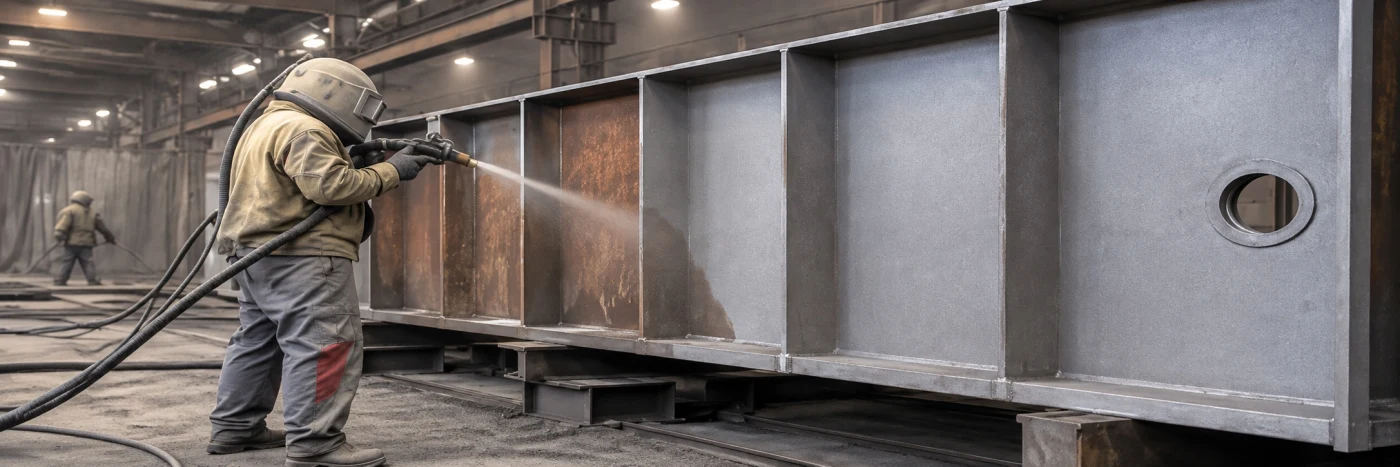
| Blasting | Shot blasting / abrasive blast cleaning | Removal of scale, rust, and old coating by spraying abrasive onto the surface with a turbine or compressed air. |
| Steel blasting | Steel shot blasting | Processing of serial profiles and plates in an automatic turbine line. Acceptance level ISO 8501-1 Sa 2½ or Sa 3. |
| Large part blasting | Large component blasting | Processing of parts that do not fit in the automatic line in a manual operator cabin. |
| Surface profile | Surface profile / anchor pattern | Roughness created after blasting. Evaluated with ISO 8503; paint adhesion depends on this. |
| Rust grade | Rust grade | Initial condition of the surface before blasting; A, B, C, and D according to ISO 8501-1. |
| Flash rust | Flash rust | Rapid re-rusting of the blasted bare surface due to moisture. The phenomenon that makes the waiting time critical. |
Paint and coating
| Turkish | English | What does it mean |
|---|---|---|
| Wet paint | Wet paint / liquid coating | Paint applied in liquid form, drying by air or chemical reaction. Unlike powder coating, it does not require an oven. |
| Industrial painting / protective coating | Industrial painting / protective coating | Protective coating applied to steel structures, machinery, and equipment. The selection criterion is the service environment, not the appearance. |
| Paint coating system | Paint coating system | The whole consisting of primer, intermediate coat, and topcoat. It is not a single product, but a system where the coats are defined together. |
| Epoxy coating | Epoxy coating | Two-component, high corrosion resistance primer and intermediate coat resin. It mattes under UV in outdoor environments and the topcoat is applied over it. |
| Polyurethane topcoat | Polyurethane topcoat | Topcoat providing UV resistance and color fastness. It is the outdoor complement to the epoxy system. |
| Zinc rich primer | Zinc rich primer | Primer providing cathodic protection. It continues to protect the steel even in scratched areas. |
| Shop primer | Shop primer / pre-construction primer | Thin primer providing temporary protection during manufacturing and assembly process. |
| Airless spray application | Airless spray application | Application of paint by spraying at high pressure without mixing with air. It provides thick films in a single pass. |
Fire protection
| Turkish | English | What does it mean |
|---|---|---|
| Fire paint / fire protective coating | Intumescent fire protection coating | Coating that swells in fire to form an insulating layer; it delays the steel reaching critical temperature. |
| Fire resistance rating | Fire resistance rating | Target duration defined between R30 and R120. The required thickness is calculated according to this duration. |
| Section factor | Section factor (Hp/A) | The ratio of the cross-sectional area of the heated surface of the profile to its surface area. It is an input for thickness calculation. |
Measurement and control
| Turkish | English | What does it mean |
|---|---|---|
| Dry film thickness | Dry film thickness (DFT) | Coating thickness measured after drying. Evaluated with the acceptance rule of ISO 19840. |
| Wet film thickness | Wet film thickness (WFT) | Thickness measured with a comb during application. It shows during application whether the target DFT will be achieved. |
| Dew point | Dew point | The temperature at which condensation begins on the surface. Application is not performed if the surface temperature is not sufficiently above this. |
| Adhesion test | Adhesion / pull-off test | Measurement of the adhesion strength of the coating to the surface. Applied when required by contract or ITP. |
| Holiday detection | Holiday detection | Electrical search for discontinuities in the coating that are not visible to the eye. |
Project and commercial terms
| Turkish | English | What does it mean |
|---|---|---|
| Corrosivity category | Corrosivity category | Environmental corrosivity load within ISO 12944: C2 to C5 and CX. This is an environmental class, not a paint brand. |
| Quality gate | Hold point | A control point where the next step cannot be taken without approval. Marked in the ITP plan. |
| Inspection and test plan | Inspection and test plan (ITP) | A plan defining which inspection is to be performed at which stage, by whom, and with which record. |
| Declaration of conformity | Certificate of conformity (CoC) | A document in the handover file declaring that the work has been completed in accordance with the specifications. |
| Third party inspection | Third party inspection (TPI) | Supervision by an independent organization on behalf of the client. The scope is clarified at the tender stage. |
Frequently asked questions
The most frequently asked questions during the quotation phase. If you cannot find what you are looking for, you can write directly.
Yes. "Shot blasting" refers to the blasting of abrasive such as steel shot or grit onto the surface with a turbine; it is called kumlama in Turkish. When "abrasive blast cleaning" or "blast cleaning" is mentioned in the specification, the same process is meant. The acceptance level is defined by ISO 8501-1 Sa degrees.
Wet paint is applied in liquid form, with solvent or water as a carrier, and dries by air or chemical reaction. Powder coating is applied electrostatically and cured in an oven. BER-GRİT applies wet paint; for large and heavy parts, as oven size is a limitation, wet paint is the only applicable method.
In a common system, an epoxy primer and intermediate coat provide corrosion resistance, while a polyurethane topcoat provides UV and color durability. Epoxy alone will mat and chalk over time in outdoor environments. The layer sequence and total DFT are determined according to the ISO 12944 corrosivity category and the paint manufacturer's technical documentation.
They are two names for the same product. The technical term is intumescent coating: it swells in fire, delaying steel reaching critical temperature. The target duration is defined between R30 and R120, and the required thickness is calculated based on the section factor.
They are not different, but two names used for the same job. Both refer to protective coatings applied to industrial surfaces such as steel structures, machinery, and equipment. It is distinct from decorative architectural paint; the selection criterion is not appearance but the service environment and corrosion load.
If your specification is in English, send it as is
Our technical team matches the terms. Part information, current surface condition, and target protection level are sufficient; we decide which blasting route and which paint system are suitable.
- Specification and drawing file can be attached
- Unknown technical fields can be left blank
- A reference number will be provided after submission